A life’s richness
isn’t measured
in years.
Let It Beinggames about well-being
BeeyHi, I’m Beey! Let’s be reborn as all kinds of lives and live each one to the very end. Not how many years it lasted, but how fulfilled it was — let’s look back on that together.
Some lives end after three days as plankton; others run a hundred years in a mountain village. Let It Being is a set of simulation games where you live one life to its end, then look back on how fulfilled it was. Finally, you step to the other side: as a mayor, you shape the lives of a thousand people. Health, joy, connection, room to breathe — what is your happiness made of?
Rinne-roku
Be reborn as 37 lives. Feeding others and passing life on earns virtue, which decides your next life.
Be born →Born in This Town
Be born in one of Japan’s 1,740 municipalities and grow old with your hometown, scoring your life satisfaction 0–10 every year.
Be born →A Thousand Lives
Be mayor for 20 years. Your policies change the lives and well-being of a thousand residents — compared with a town where nothing was done.
Take office →A Straw’s Journey
Start with a single straw and travel Japan, trading for local flowers, specialties and secondhand finds. What you hold, and the ties you make.
Be born →Antibody Puzzle
Team up with Shiro, the white blood cell, and match antibodies to virus shapes to protect Hal’s body. Learn why fevers happen, how vaccines work, and how DNA is built, all while you play.
Protect →Lv.1 Seed Life points 0
Every life you finish in any of the four games earns life points, and Beey grows: Seed → Sprout → Seedling → Leafling → Bud → Blossom → Fruit → Great Tree.
Life points that build up as you play, a stamp book for each game (43 stamps in all), a daily challenge that changes every day, and a dash of luck. Tap Beey at the bottom left of any game to see your stamps and today’s challenge.
News
- No news yet.
How would life in Japan score, out of 10?
Japan’s Cabinet Office asks people how satisfied they are with their life right now, on a scale of 0 to 10. In 2025 the national average was 5.79. In the World Happiness Report 2026, which compares countries on the same kind of scale, Japan ranked 61st of 147.
BeeyTry measuring your life right now on this scale. My score? It depends on how perky my leaves are.
Move the slider to pick how satisfied you are with your life now. Your answer is not sent anywhere.
Well-being in the games is built from four things.
BeeyHappiness isn’t decided by one yardstick. More money alone won’t perk up my leaves. Body, Heart, Ties and Savings — it’s the balance that counts.
In Born in This Town, each year’s life satisfaction is calculated from four states, following the Cabinet Office’s approach of looking at satisfaction area by area. Neither money alone nor a long life alone gets you a perfect score.
Body · health
Time for yourself, and not overworking. It slowly declines with age.
Closest survey area: healthHeart · everyday joy
Time with family, marriage and raising children, a sense of purpose.
Closest survey area: enjoyment of lifeTies · connection
Local festivals, the volunteer fire brigade, reunions, neighbors. The deeper they are, the more help reaches you in old age.
Closest survey area: social connection, friendshipsSavings · room to breathe
Work and household money. The more you build it, the less time is left for Body and Ties.
Closest survey area: household finances and assetsIs a short life a poor life?
Rinne-roku
Everyone starts as a tiny plankton drifting in the sea. Even a life eaten after three days feeds the fish and makes the ocean’s oxygen. In Rinne-roku, becoming food for other lives, passing life on and protecting others count as virtue, and virtue decides the realm of your next birth. It measures richness by your ties to everything outside yourself.
BeeyIn Rinne-roku I get reborn too — as plankton, as a cedar tree. A life of three days is still a rich one if it fed someone else.
Eight endings
Escaping the cycle isn’t the only fulfilling endWhere, with whom, and how should you spend your time to feel fulfilled?
Born in This Town
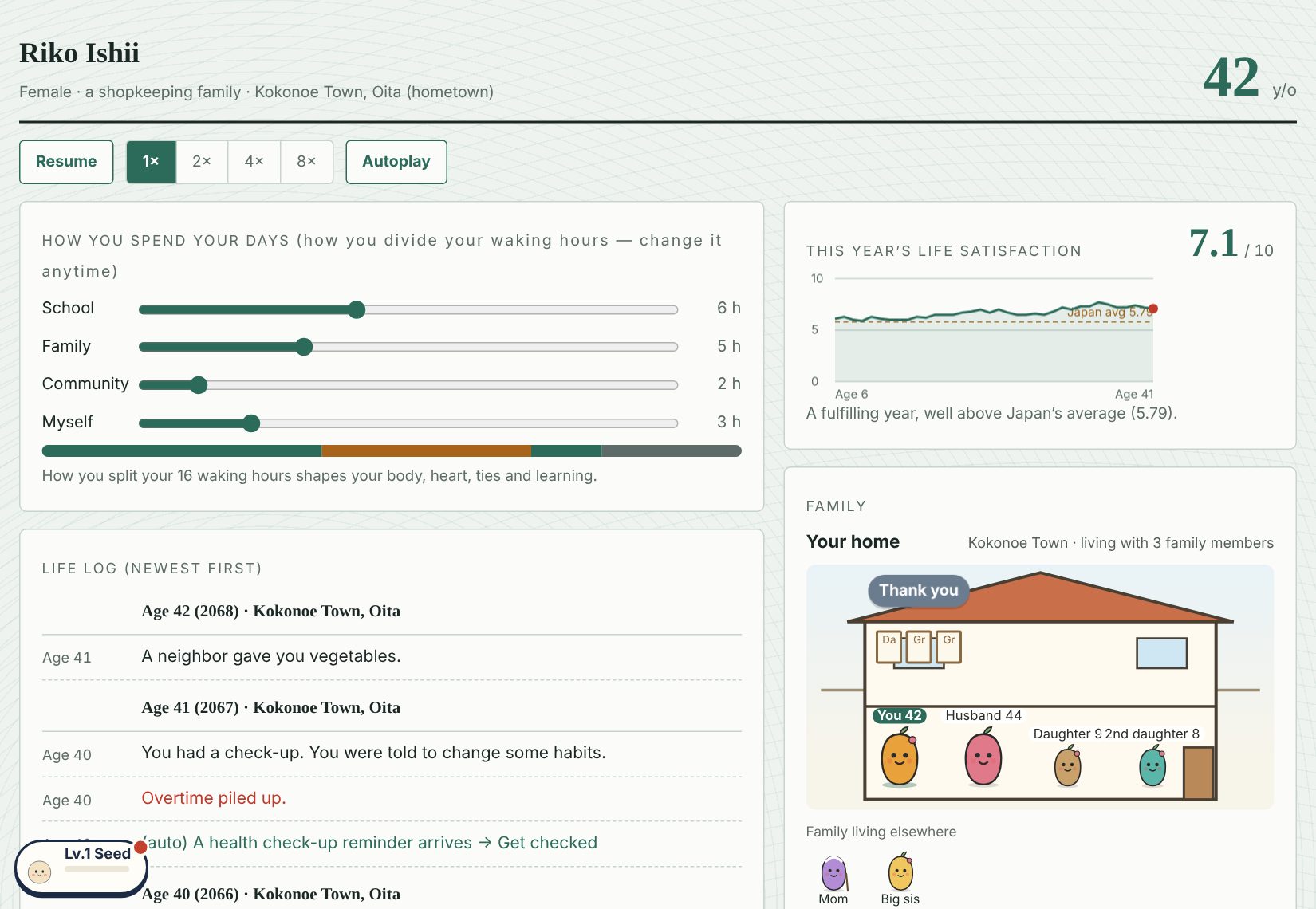
You are born somewhere among Japan’s 1,740 municipalities. You choose how to split each day between work, family, community and yourself, and your life satisfaction is recorded every year on a 0–10 scale. Move to Tokyo to earn more, or deepen your ties at home? At the end you look back on your lifetime average — and meet your “what-if self.” What if you had taken the other road at that fork? The game runs a second life from the same birth so you can compare.
BeeyYou’ll be born in one of Japan’s 1,740 towns. At the end you can compare yourself with your what-if self. What if you hadn’t moved to Tokyo? Hadn’t married? You get to see the life on the road not taken.
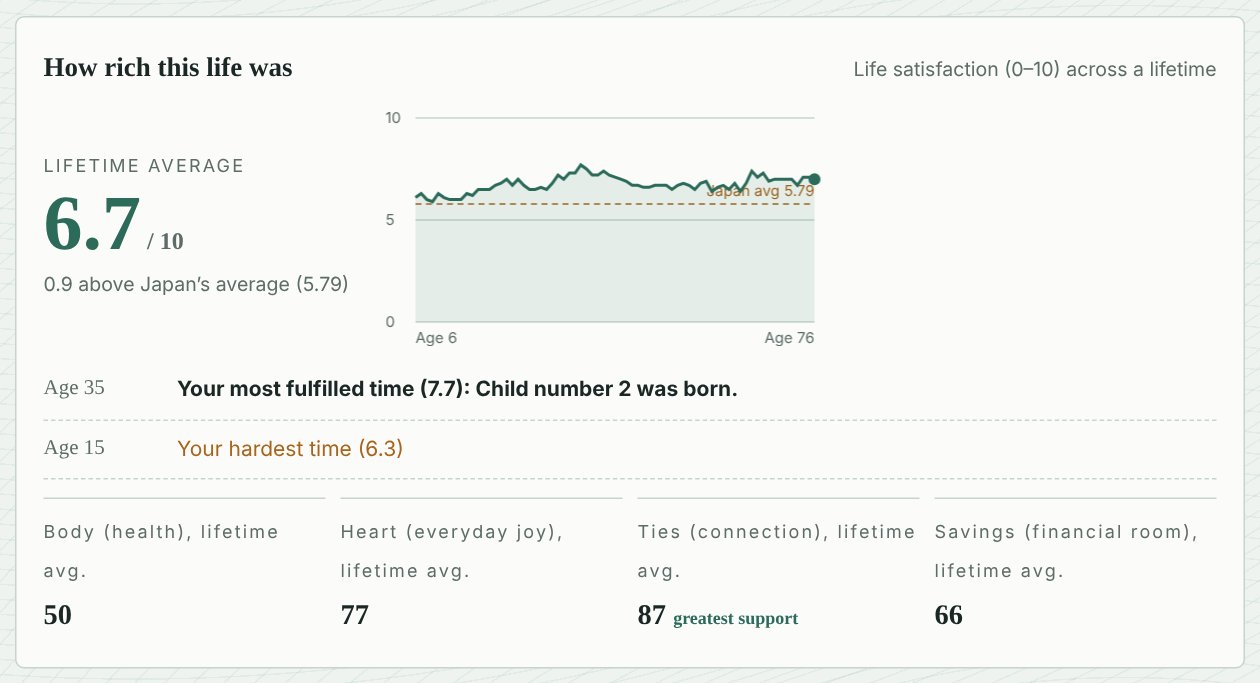
Your what-if self
College, moving to Tokyo, coming home, marriage. The game remembers your big forks and, at the end, runs the life of the you who chose differently. Compare satisfaction, age at death and final home side by side.
Your hometown’s population pyramid
Your town’s population changes shape year by year. Can you keep your ties alive as the town shrinks?
Choose your own town
Be born in your hometown or where you live now — a handy way to think about well-being in your own community.
You can’t choose where you’re born. But you can change the town people are born into.
A Thousand Lives
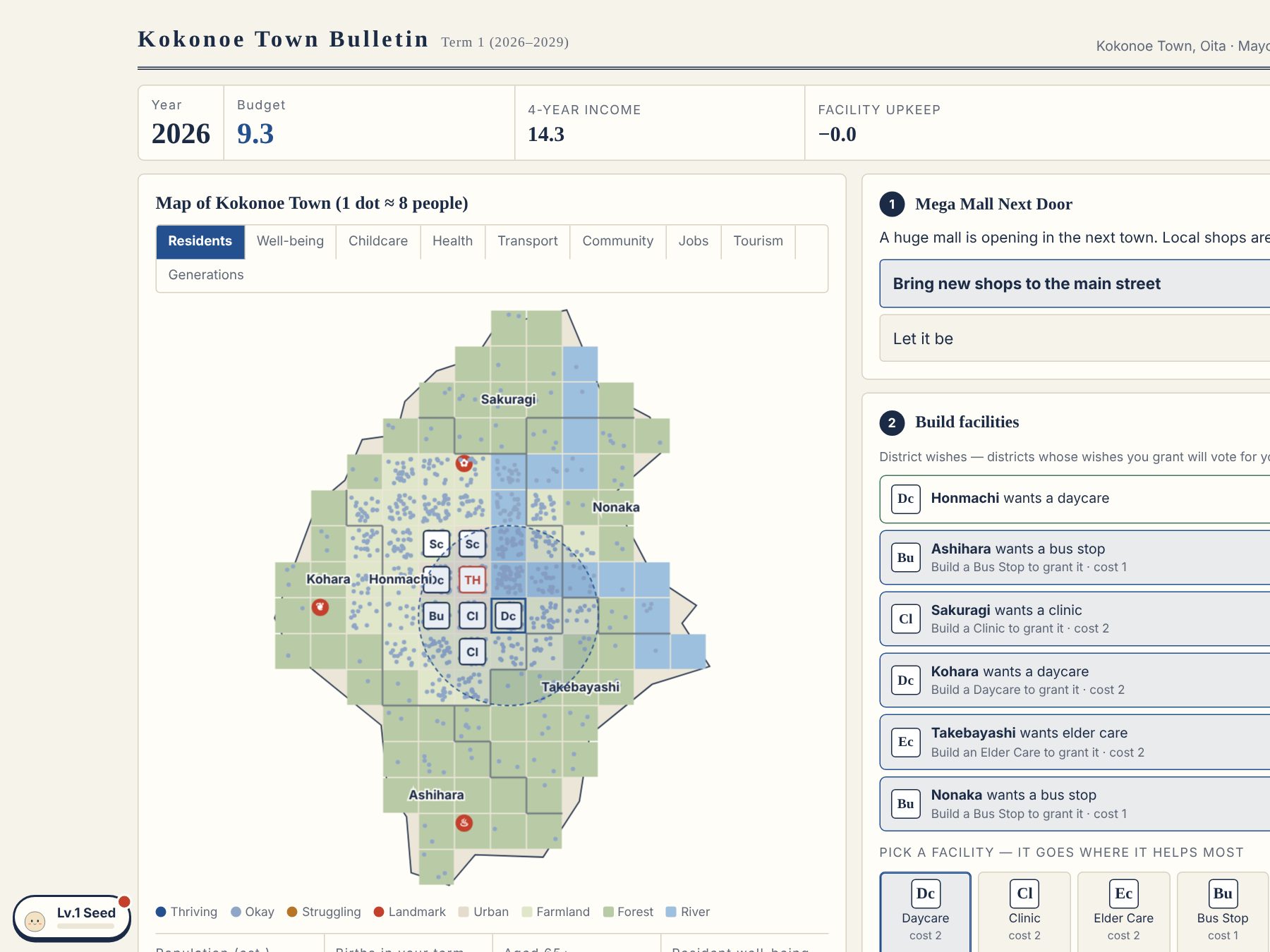
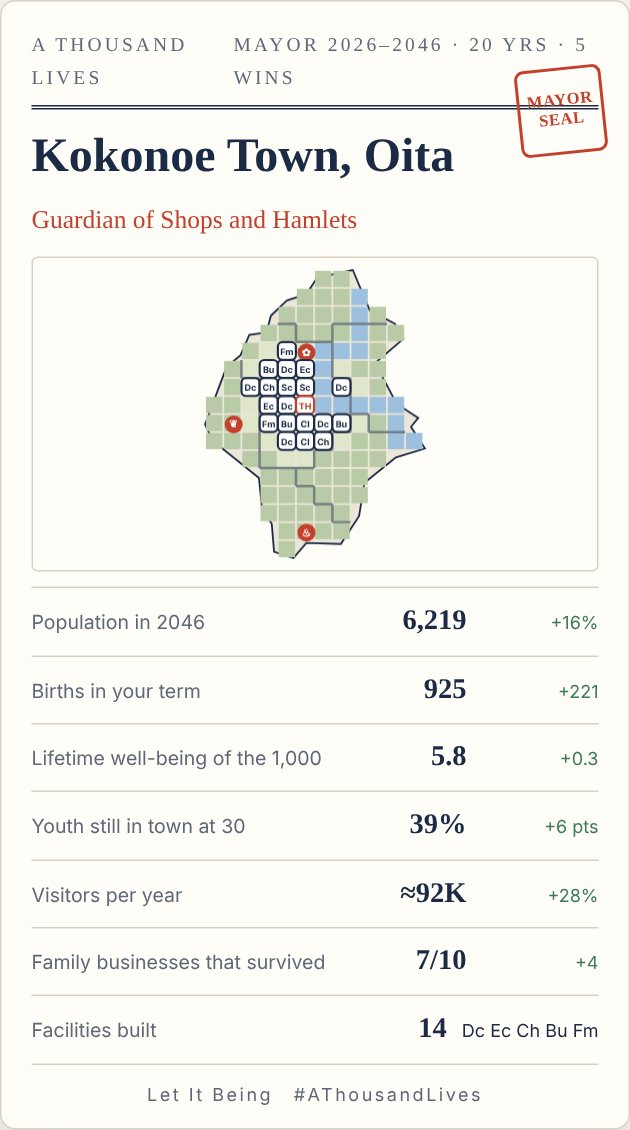
From today, you are mayor, for 20 years. On a map shaped like a real town, you build daycares, clinics, bus stops, factories and inns. A facility only helps the people who live around it. Grow industry and tourism from fields, forests, hot springs and cherry-lined streets, and respond to more than 30 events as the seasons turn. The town is split into 4–8 districts, each with its own wishes. Shops and farms face succession, and close if no one takes over. Balance taxes against upkeep, and win a mayoral election every four years, counted district by district. Behind the scenes the same town also runs as if nothing had been done, so at the end you see how many children were born in your 20 years — and how fulfilled a thousand people were when their lives ended.
BeeyNow you’re the mayor! Build facilities on the map and grant the districts’ wishes. There’s an election every four years, so listen to the residents.
Where to build
A clinic near the town hall reaches many people, but not the mountain hamlets. Every facility costs upkeep each year, and fewer people means less tax.
District wishes and elections
“We want a bus stop.” “We want a daycare.” Districts whose wishes you grant vote for you. Lose an election and your time as mayor ends then and there.
Industry, tourism and the seasons
An inn near a landmark brings tourists; farm stands suit the fields, sawmills the mountains. Snow-country winters bring heavy snow, and older people in districts without a bus struggle.
Is your greatest treasure what you hold, or who you met?
A Straw’s Journey
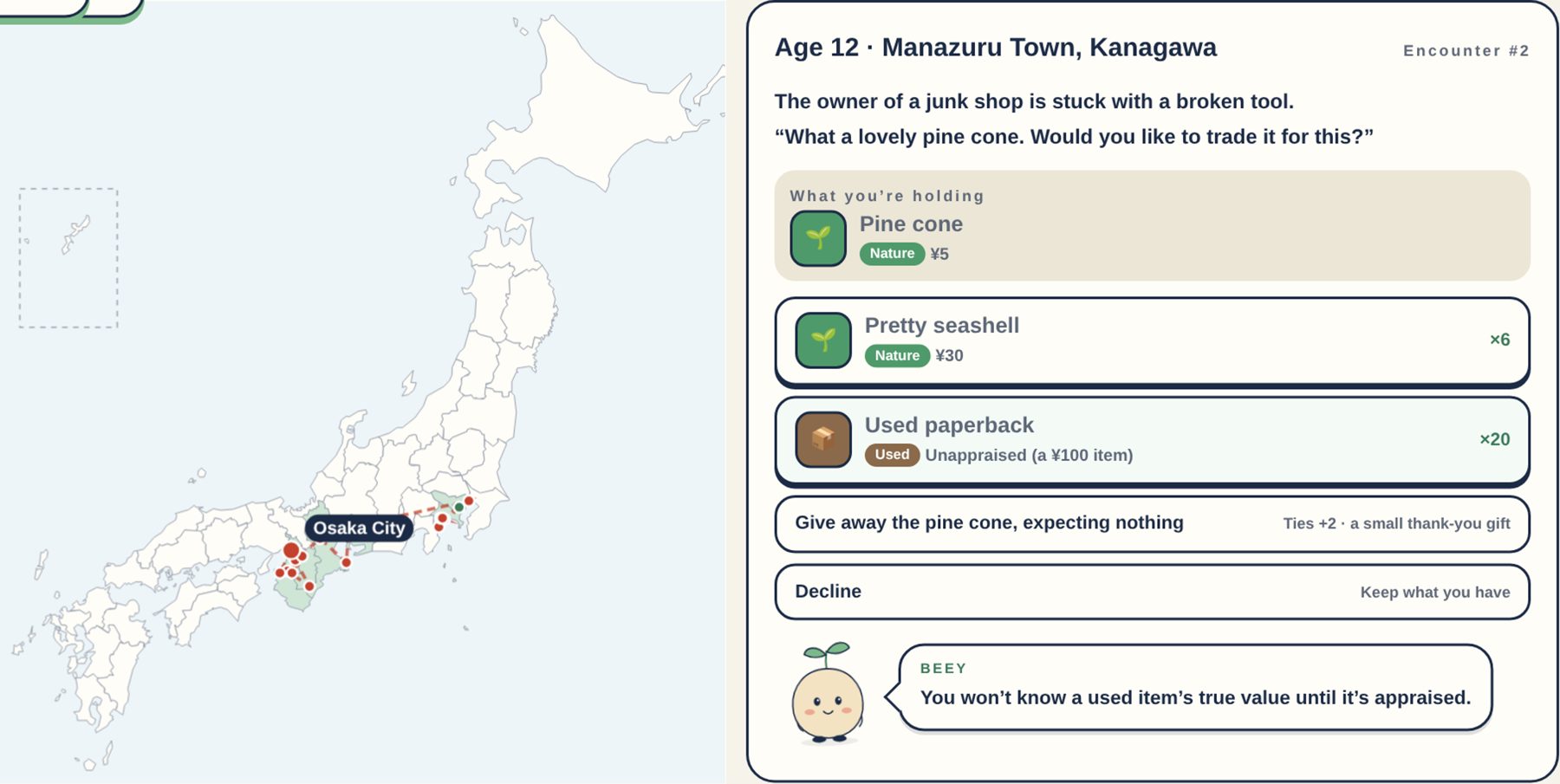
You are born in one of Japan’s 1,740 towns, and one summer at age seven you trip and grab a single straw. Every five years you meet someone new and trade — local flowers, regional specialties, secondhand finds from a junk shop — traveling Japan over a lifetime. Have what someone needs, and you’ll get something good in return. Give freely, and your ties deepen; one day the kindness comes back. At the end you look back on the richness of your life through both what you held and the ties you made.
BeeyYou don’t know what a secondhand item is really worth until it’s appraised. Treasure or junk? So exciting!
Goods from 47 prefectures
Beach roses from Hokkaido, apples from Aomori, tea from Shizuoka, Ryukyu glass from Okinawa. Meet the flowers and specialties of the places you travel.
Secondhand stays secret until appraised
An old boombox, a vintage film camera, a used fishing boat. A real find is worth four times as much; junk, a third.
Give, and ties come back around
Someone you gave to freely may return the kindness years later. The ties you make count toward the richness of your life too.
Antibody Puzzle
Team up with Shiro, the white blood cell, and match antibodies to virus shapes to protect Hal’s body. Learn why fevers happen, how vaccines work, and how DNA is built, all while you play.
How to play
BeeyIt’s simple: be born, make choices, look back. That’s it! If you can’t decide, tap Auto and just watch.
Be born
What and where you’re born is decided. In Born in This Town you can also pick the town.
Spend time, make choices
Choose how to live at each fork and divide your days. If you’re unsure, let Auto play while you watch.
Look back on the richness
Not how many years you lived, but what held you up and how fulfilled you were.
Use it for learning
School classes
For inquiry-based learning, ethics or local studies. Be born in your own town, then discuss its future and well-being.
Workplace well-being training
Experience the link between how you work and how happy you are, over a whole lifetime. Change how you divide your time and compare the results.
Local government and community building
How do you keep people connected in a shrinking town? Run your own town in A Thousand Lives as a starting point for workshops on policy with residents.
FAQ
BeeyIf something’s unclear, look here!
No. There are no ads either.
No. Open the page and start playing.
Japan’s 5.79 average comes from the Cabinet Office’s Survey on Satisfaction and Quality of Life, and 61st place from the World Happiness Report 2026. Satisfaction in the games is calculated along the same lines; it isn’t any real person’s score.
Only in the browser you play in. Nothing is sent to a server, including the score you pick on the scale.
Please do. Born in This Town has a setting that tones down heavy events. Policy effects in A Thousand Lives come from a simplified model made for the game.
A life in Rinne-roku takes 30 seconds to 2 minutes; Born in This Town and A Thousand Lives take about 10 minutes. It works on phones, in spare moments.